A leak site is not a source: how to read the BYOD ransomware claims against Vanderbilt and Toyota.
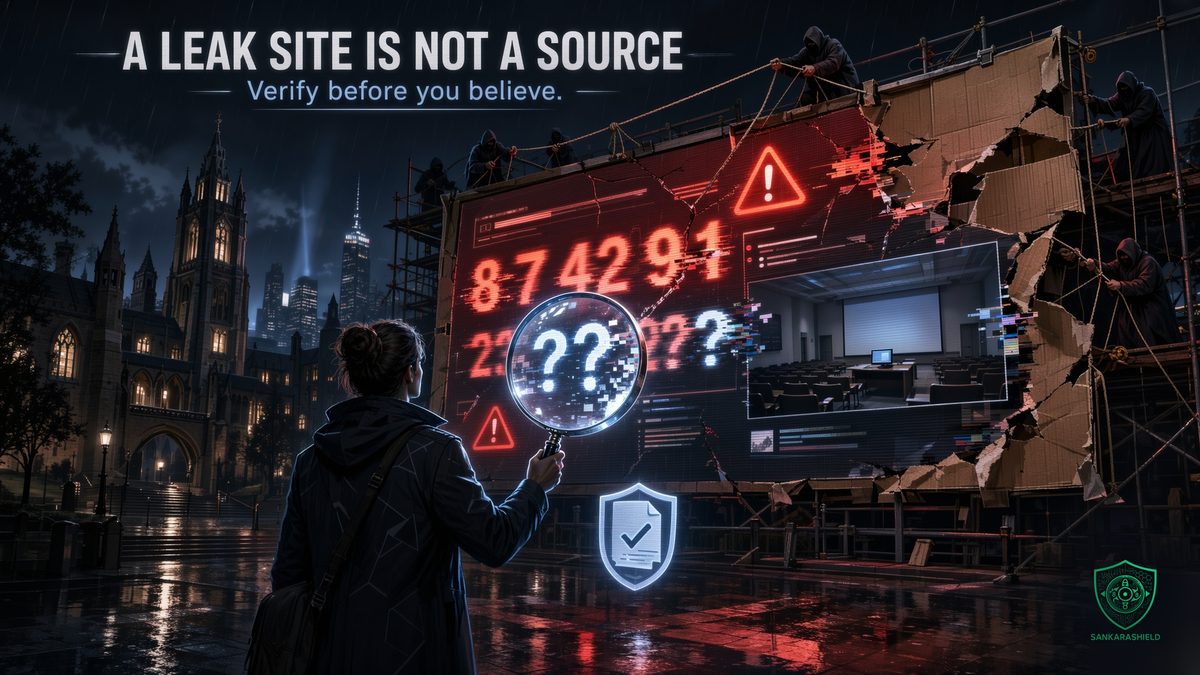
"More than one million Social Security numbers." That is what a ransomware group says it took from Vanderbilt University. It may be true. It may be inflated. Right now, nobody outside the attackers and the university knows.
On Monday 9 November 2026, Vanderbilt University in Nashville discovered a ransomware attack. The university told students, faculty and staff to shut down their university devices and disconnect from campus Wi-Fi while its IT team worked to contain the situation. A group calling itself BYOD claimed the attack on its leak site. The next day, a separate BYOD listing claimed a breach involving Toyota.
This brief separates what is confirmed from what is claimed, and explains what both defenders and readers should do with a ransomware claim.
WHAT IS CONFIRMED AT VANDERBILT
THE DISCOVERY — Vanderbilt says it discovered the attack on Monday 9 November. Its first notice said IT was "actively investigating and working to contain the situation."
THE SHUTDOWN — the university asked its community to power off university devices and leave the campus Wi-Fi. Several digital services were taken offline intermittently during the response, and Vanderbilt acknowledged that containment had disrupted normal communications.
THE RECOVERY — by Tuesday morning, campus Wi-Fi, Okta, Outlook, Brightspace, Zoom and the YES student system were declared safe to use again, and people could turn their Vanderbilt devices back on. CampusPrint remained restricted.
THE INVESTIGATION — Vanderbilt says its IT team "continues to work with government agencies and other partners to manage this situation." It has not published what data, if any, was taken.
WHAT BYOD CLAIMS
VANDERBILT — BYOD claims to hold more than one million Social Security numbers from the attack. It also posted a video showing a Vanderbilt computer playing an audio message that says the system was compromised by BYOD.
TOYOTA — on 10 November, a BYOD listing claimed it obtained personal information and access involving "kiosk devices." The listed data types are full names, email addresses, physical addresses, phone numbers and dates of birth. The listing does not name a Toyota business unit, country, dealer or service provider, gives no number of affected people, and shows no entry point. BYOD says "much of the environment was isolated" but that it found "remaining access paths." No Toyota response had been reported at the time of writing.
THE GROUP — BYOD appeared in the fall of 2026 and has claimed attacks on academic and health care institutions. CyberScoop reports that last month it hit the University of New Mexico Health Sciences Center, causing outages that disrupted patient care and academics.
WHY A LEAK SITE IS NOT A SOURCE
A ransomware leak site is not journalism and not a disclosure. It is an extortion tool. Its job is to raise the pressure on the victim, through employees, students, customers, regulators and the press, until paying looks cheaper than staying silent.
That has consequences for anyone who reads it
BIG NUMBERS ARE PART OF THE PITCH — a round, frightening figure is a negotiation tactic. Sometimes it is accurate, sometimes it counts the same record several times, and sometimes it describes data the group saw but could not take.
THEATRE IS PART OF THE PITCH — a computer playing a message, a countdown, a screenshot of a folder tree. These prove access to something, at some point. They do not prove the volume or the type of data stolen.
UNVERIFIED DOES NOT MEAN FALSE — groups that lie too often lose leverage, so many claims turn out to be at least partly real. The right posture is not belief or dismissal. It is "not confirmed yet."
HOW TO READ A RANSOMWARE CLAIM
SEPARATE THE TWO STORIES — outages, shutdown orders and the victim's own statements are facts. Data volumes, victim lists and descriptions of the breach come from the attacker until someone else confirms them.
ASK FOR PROOF, NOT ADJECTIVES — sample files, dates, system names and record formats are evidence. A large number on its own is not.
CHECK THE SCOPE — "Toyota" on a leak site can mean a manufacturer, a regional subsidiary, a dealer or a supplier. A claim that names no unit and no country deserves extra caution.
WATCH THE VICTIM'S NEXT STEPS — confirmed exposure of personal data usually leads to formal notifications to the people affected. That is the moment a claim becomes a fact.
DO NOT DOWNLOAD LEAKED DATA — leak archives contain other people's stolen personal information, and they are a known lure for malware. Curiosity is not a reason to handle either.
WHAT ORGANIZATIONS SHOULD TAKE FROM THIS
The attacker controls the leak site. The victim controls everything else, and the preparation happens long before the attack.
PREPARE THE COMMUNICATION, NOT ONLY THE TECHNICAL RESPONSE — at Vanderbilt, student government leaders said they were "frustrated by the university's lack of clear communication." When the victim says little, the attacker's version fills the silence. Pre-approve holding statements, decide who speaks, and plan an out-of-band channel in case email and the intranet are down.
REHEARSE THE BIG SHUTDOWN — telling thousands of people to power off their devices is a legitimate containment step, but it only works if users, help desk and leadership have practiced it. Know who can order it and how you will tell people when it is safe to turn devices back on.
PROTECT IDENTITY FIRST — single sign-on and email were among the first services Vanderbilt brought back, because almost everything depends on them. Phishing-resistant MFA, separate administrator accounts, and tight control of the identity provider's admin roles limit how far one stolen login can go.
SEGMENT WHAT HOLDS THE MOST SENSITIVE DATA — student records, HR and health systems should not be reachable from the general campus network. Ransomware groups move laterally; segmentation and strict east-west firewall rules turn one compromise into a contained incident.
KEEP OFFLINE, TESTED BACKUPS — immutable or offline copies, and a measured restore time for the systems you cannot live without. A backup you have never restored is a hope, not a plan.
WATCH FOR THE EXIT — large outbound transfers from file servers or databases, especially to cloud storage you do not use, are often the last chance to stop data theft before it becomes a leak-site post.
KNOW YOUR OBLIGATIONS IN ADVANCE — which agencies you call, which notification laws apply to student, employee and patient data, and which deadlines start when.
FOR STUDENTS, EMPLOYEES AND CUSTOMERS
If you study or work at Vanderbilt, or you are a Toyota customer worried about this claim, the risk in the coming weeks is less the leak itself than the scams built on it.
Treat any email, text or call about "the breach" as suspicious, especially if it asks you to click, log in or confirm personal details. Go directly to official university or company channels instead. Watch your accounts, consider a credit freeze if you receive an official notice that your Social Security number was exposed, and turn on phishing-resistant MFA where you can.
WHAT TO READ WITH CARE
This brief is based on reporting by CyberScoop and Cyber Security News on 10 November 2026, and on Vanderbilt's own notices as quoted there. Vanderbilt has not confirmed what data was taken. Toyota had not responded to the claim at the time of writing, and the listing does not identify which part of Toyota, if any, is involved. The data volumes and descriptions attributed to BYOD are the attackers' claims and have not been independently verified.
THE BOTTOM LINE
Ransomware is now two attacks: one on your systems, and one on your story. The first is stopped with segmentation, identity controls and backups. The second is stopped with preparation and clear, honest communication.
Does your incident response plan say what you will tell people, who will say it, and how you will reach them if email is down?