Hackers no longer just steal data. They now shut down power grids, poison water supplies, and stop production lines.
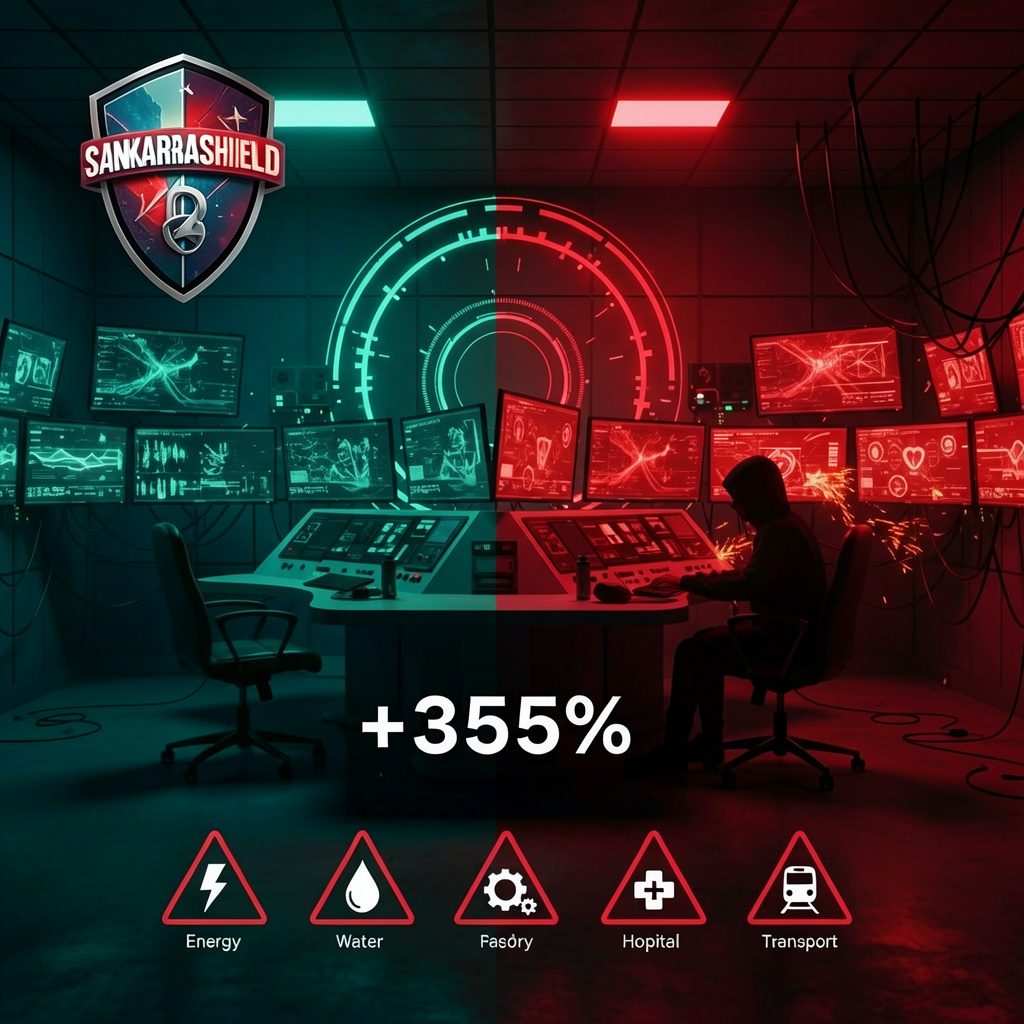
OT/ICS cyberattacks with physical consequences increased 355% between 2020 and 2025.
The battlefield has changed.
What is OT/ICS: Operational Technology and Industrial Control Systems run factories, power plants, water facilities, hospitals, and transport networks. Built for reliability — not security. Most operate 20+ years without patching. Many use 1990s protocols with zero authentication.
Why attackers are shifting to OT/ICS
- MAXIMUM LEVERAGE Ransomware on a database creates urgency. Ransomware that halts a hospital or a city's water supply creates panic. Victims pay faster and pay more.
- LEGACY SYSTEMS Industrial hardware runs for decades. Patching disrupts operations. Replacing equipment costs millions. Attackers find doors that have never been closed.
- IT/OT CONVERGENCE Efficiency drives IT and OT network connections. But a phishing email on an office laptop can now reach a turbine controller or a chemical dosing system.
- ZERO VISIBILITY Only a fraction of OT environments detect intrusions before physical damage occurs. Attackers dwell inside networks for months, mapping control loops, waiting.
- NATION-STATE ESCALATION Dragos tracks 26 active OT threat groups globally. In December 2025, state-sponsored actors compromised energy plants in Poland. AZURITE and PYROXENE are trained to manipulate industrial processes — not just IT.
Real consequences: Grid attacks trigger cascading blackouts. Compromised water controllers silently alter chemical dosing before anyone can intervene. One day of manufacturing downtime costs millions. Hospital OT attacks have put patients at direct risk.
How to build resilience
ASSET VISIBILITY — Inventory every OT asset and communication flow. You cannot protect what you cannot see.
NETWORK SEGMENTATION — IT and OT must be strictly separated. Lateral movement between environments must be impossible by design.
OT-SPECIFIC MONITORING — Standard tools are blind to protocols like Modbus and DNP3. Dedicated OT solutions detect anomalies that IT tools miss entirely.
INCIDENT RESPONSE — Exercises must simulate physical consequences. Who overrides a compromised safety system? What happens when the safety system itself is the target?
VENDOR ACCESS — Most OT breaches enter through third-party remote connections. Every vendor access must be authenticated, logged, and time-limited.
NIS2, CISA, and sector mandates are tightening. Build resilience before the incident — not after.
An OT breach is not measured in leaked records. It is measured in hours without power, liters of contaminated water, and lives at risk.
Does your organization have visibility into its OT environment? When was your last ICS-specific security assessment?