TLS 1.3 vs TLS 1.2: It's Not Just a Number.
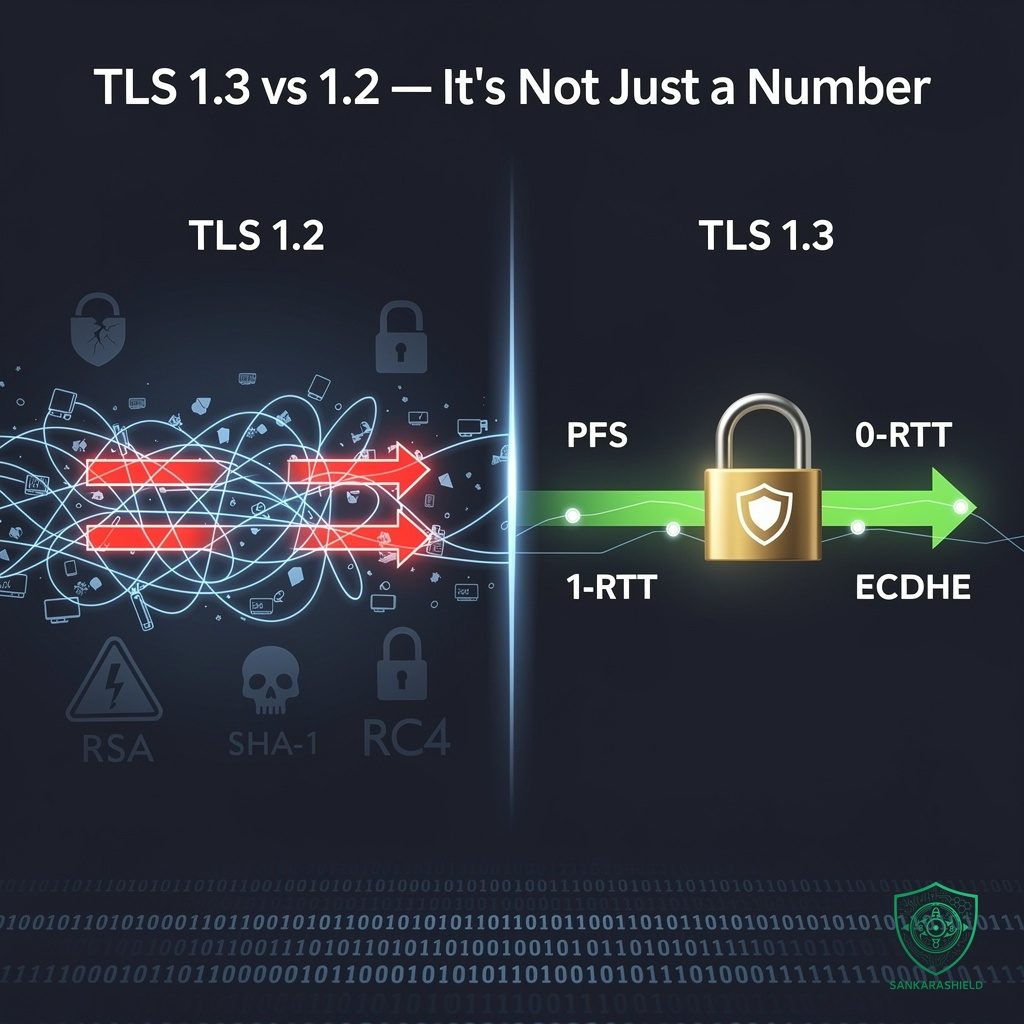
Most engineers treat it as a minor version bump. It isn't. TLS 1.3 is a fundamental redesign of how secure connections are established — and the gap between the two protocols is wider than most teams realize.
Here's what actually changed.
THE HANDSHAKE: 2-RTT 1-RTT
TLS 1.2 requires two full round-trips before any application data can flow: client hello, server hello, key exchange, finished — all before a single byte of your payload moves.
TLS 1.3 cuts that to one. The client sends its key share upfront. The server responds with its share, certificate, and finished in a single flight. On a 50ms RTT link, that's 100ms saved on every new connection. At scale, that's real.
- WHAT GOT REMOVED AND WHY IT MATTERS
TLS 1.3 didn't just add features. It deleted entire attack surfaces
- RSA key exchange: gone. One key leak could decrypt all past traffic. - SHA-1 and MD5: gone. Cryptographically broken. - CBC cipher suites: gone. Eliminated BEAST, POODLE, and Lucky13 at the protocol level. - RC4: gone. - TLS compression: gone. CRIME attack made it untenable.
Not backward-compatible patching — deliberate removal of an entire generation of weak cryptography.
PERFECT FORWARD SECRECY IS NOW MANDATORY
In TLS 1.2, PFS was optional. Many deployments used static RSA key exchange, meaning a key compromise today could retroactively decrypt traffic captured years ago.
In TLS 1.3, ephemeral Diffie-Hellman is mandatory. Every session generates its own independent key. A private key leak tomorrow doesn't expose yesterday's sessions.
In 2026, this is non-negotiable.
0-RTT RESUMPTION: FAST, WITH A CATCH
TLS 1.3 supports 0-RTT resumption for returning clients — application data sent before the handshake completes. Zero latency on reconnections.
The catch: 0-RTT data is replay-vulnerable. An attacker who captures it can resend it. Enable 0-RTT only on idempotent endpoints — read-only calls, static assets. Never on authentication flows, payments, or state-changing operations.
TLS 1.0 AND 1.1: VULNERABILITIES, NOT OPTIONS
POODLE, BEAST, DROWN. These attacks target TLS 1.0 and 1.1 specifically. They are documented and exploitable today. PCI-DSS 3.2 mandated TLS 1.2 as the minimum years ago.
In 2026, having TLS 1.0 or 1.1 active on any public-facing endpoint — load balancer, API gateway, web server — is unacceptable.
Check your stack: nginx: ssl_protocols TLSv1.2 TLSv1.3; Apache: SSLProtocol -all +TLSv1.2 +TLSv1.3 Audit with: testssl.sh or nmap --script ssl-enum-ciphers
The version number is the least interesting detail. The cryptographic decisions behind it are what determine your real security posture.
Is your infra already running TLS 1.3 exclusively? What's blocking migration in your environment?