CCNP has seven tracks. Most engineers pick the wrong one
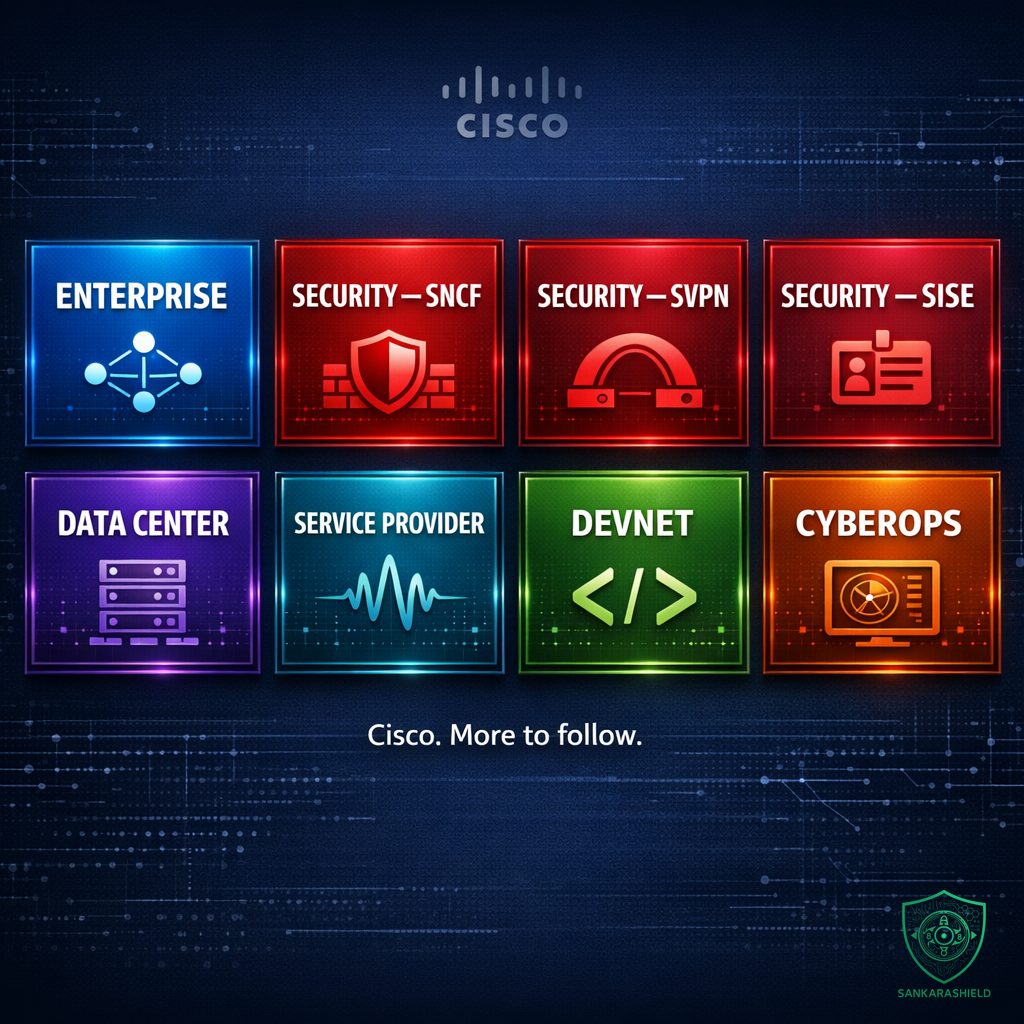
not because they lack knowledge, but because they don't understand what each track actually certifies.
A certification is a commitment. Choosing the wrong one costs twelve to eighteen months. Here is what each track covers and who it is built for.
We start with Cisco today. The other vendors follow.
CCNP ENTERPRISE
Advanced routing (OSPF, BGP, EIGRP), switching, SD-WAN, and wireless. Concentrations: ENARSI for routing depth, ENSDWI for SD-WAN, ENWLSI for wireless infrastructure.
Built for: network engineers managing multi-site enterprise infrastructure.
- CCNP SECURITY SNCF (Firewall)
Firepower, Cisco Secure Firewall. Threat policy, intrusion prevention, malware inspection, application control. Hands-on firewall deployment — not a conceptual exam.
Built for: security engineers who own the perimeter.
- CCNP SECURITY SVPN (VPN)
Site-to-site IPsec, FlexVPN, DMVPN, remote access SSL VPN. IKEv2, cryptographic policy, tunnel negotiation, failover design.
Built for: engineers designing VPN infrastructure at enterprise scale. VPN failures are always P1.
- CCNP SECURITY SISE (Identity)
Cisco ISE. 802.1X, RADIUS, TACACS+, posture assessment, TrustSec segmentation. One of the most complex concentrations in the Security track.
Built for: zero-trust architects managing network access control at scale.
CCNP DATA CENTER
Nexus switching, ACI fabric, storage networking, UCS compute. Entirely different technology stack from Enterprise.
Built for: engineers in hyperscale or enterprise DC environments.
CCNP SERVICE PROVIDER
Carrier-grade routing, MPLS, Segment Routing, BGP at ISP scale. Technically the hardest track.
Built for: engineers inside ISPs, carriers, or large national networks. Not relevant for enterprise roles.
CCNP DEVNET
Python, REST APIs, Ansible, Terraform, YANG/NETCONF, CI/CD for network automation. No hardware configuration.
Built for: engineers moving toward infrastructure-as-code or SRE roles.
CCNP CYBEROPS
SOC operations. Threat detection, SIEM, incident response, malware analysis. Blue team certification.
Built for: SOC analysts. Different from CCNP Security — no infrastructure layer involved.
The track defines the role you are certifying for.
CCNP Security SNCF is not CCNP CyberOps. SVPN is not SISE. Choosing between them is a career decision, not a study preference.
Which track are you pursuing — and does it match the work you are actually doing?