Palo Alto Networks has six certification paths
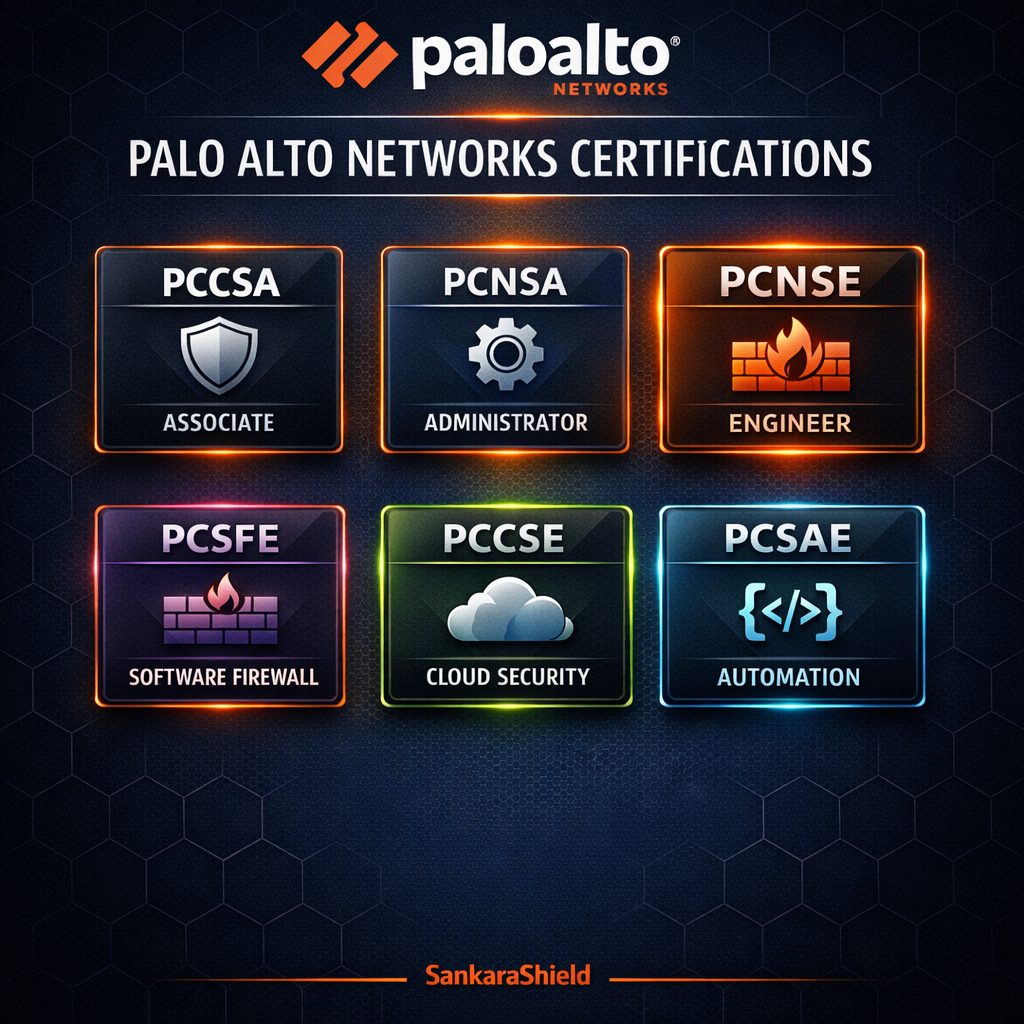
Most engineers default to PCNSE — without realizing there are distinct tracks built for different roles.
A certification is a commitment. Choosing the wrong one costs twelve to eighteen months. Here is what each path covers and who it is built for.
Cisco was first. Now Palo Alto.
- PCCSA CYBERSECURITY ASSOCIATE
Entry-level. Fundamentals of network security, threat landscape, firewall concepts, and the Palo Alto ecosystem. No hands-on lab requirement.
Built for: engineers entering cybersecurity or professionals transitioning from other vendors.
- PCNSA NETWORK SECURITY ADMINISTRATOR
NGFW administration. Security policies, NAT, App-ID, User-ID, URL filtering, basic VPN. Operational-level knowledge of PAN-OS.
Built for: administrators managing day-to-day firewall operations. Not a design certification.
- PCNSE NETWORK SECURITY ENGINEER
Advanced PAN-OS. High availability, Panorama, GlobalProtect, IPsec VPN, routing, troubleshooting at depth. The industry benchmark for Palo Alto field engineers.
Built for: engineers who own firewall architecture and deployment at enterprise scale.
- PCSFE SOFTWARE FIREWALL ENGINEER
VM-Series and CN-Series. Firewall virtualization, cloud-native deployment, Kubernetes environments, automated provisioning. Distinct from hardware-focused PCNSE.
Built for: engineers operating firewalls inside cloud infrastructure or container environments.
- PCCSE CLOUD SECURITY ENGINEER
Prisma Cloud. CSPM, CWPP, CIEM, container security, IaC scanning. Covers AWS, Azure, and GCP posture management. Entirely different stack from PCNSE.
Built for: cloud security engineers and DevSecOps teams securing multi-cloud workloads.
- PCSAE SECURITY AUTOMATION ENGINEER
Cortex XSOAR. Playbook development, Python scripting, API integrations, incident response automation. No firewall configuration.
Built for: security engineers building SOC automation pipelines. This is a developer-adjacent certification.
The track defines the role you are certifying for.
PCNSE is not PCCSE. PCSAE is not PCNSA. One covers firewall engineering. The other covers cloud posture. The other automates responses. They are three different jobs.
Which path are you pursuing — and does it match the work you are actually doing?