SASE is no longer just a networking architecture.
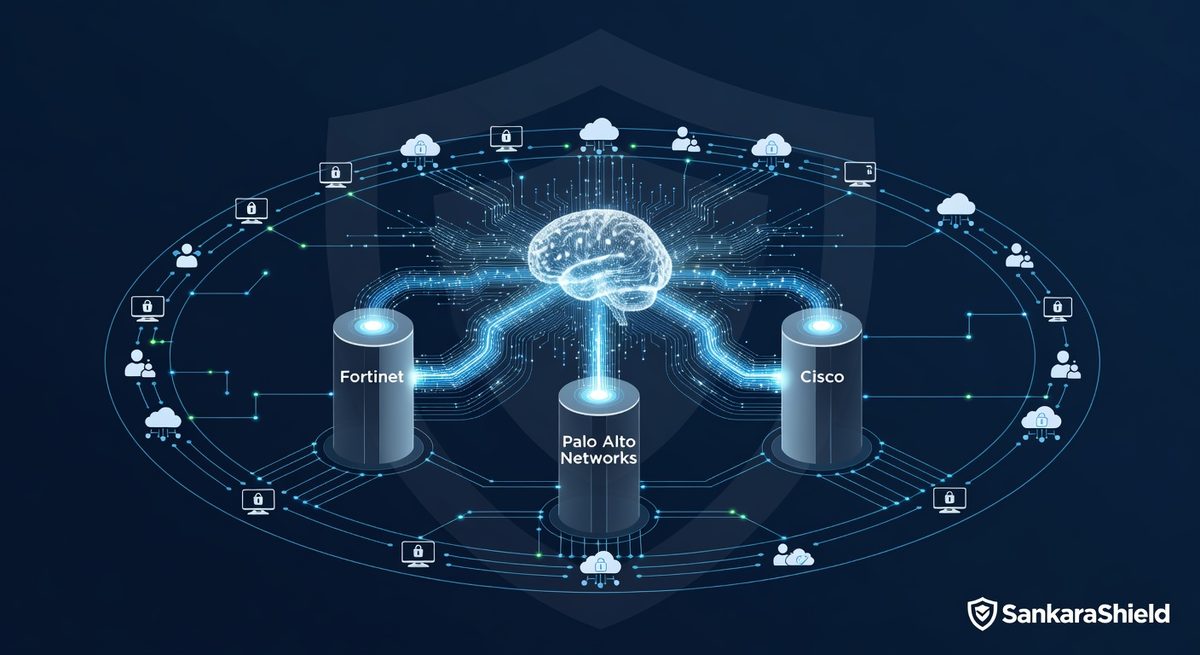
In 2026, Fortinet, Palo Alto Networks, and Cisco have embedded generative AI into the core of their SASE platforms. The result is not smarter dashboards. It is autonomous policy enforcement, real-time threat correlation, and natural language network management at scale.
The competitive landscape has shifted. Here is where each vendor stands.
- FORTINET — AI-NATIVE SASE WITH FORTIAIOPS FortiSASE integrates FortiAIOps for continuous network health prediction and automated policy optimization. The platform applies LLM-powered anomaly detection trained on FortiGuard intelligence — over 100 billion daily security events. Administrators define access policies in natural language. It translates intent into enforcement rules. Policy error rates drop. Containment time shrinks.
PALO ALTO NETWORKS — STRATA CLOUD MANAGER AND AI ACCESS SECURITY Prisma SASE has evolved around Strata Cloud Manager and a dedicated AI Access Security layer. The platform monitors and enforces policies on enterprise use of generative AI tools — ChatGPT, Copilot, Gemini — at the network layer. Shadow AI becomes visible and governable. Precision AI delivers real-time encrypted traffic inspection without the traditional SSL decryption performance cost.
- CISCO — HYPERSHIELD AND THE DISTRIBUTED ENFORCEMENT FABRIC Cisco embeds enforcement directly into infrastructure — switches, routers, cloud instances — through HyperShield. AI manages distributed policy at scale across the entire fabric. Cisco AI Defense adds detection for prompt injection and model manipulation targeting enterprise AI workloads. SASE becomes an enforcement fabric, not a perimeter.
What this means for security teams
- SHADOW AI GOVERNANCE Every enterprise has employees using unapproved AI tools. SASE platforms now detect, log, and enforce policies on those sessions. Data loss prevention extends to LLM interactions.
- AUTONOMOUS THREAT RESPONSE Mean time to respond drops to seconds. AI-generated playbooks execute containment automatically. Human analysts focus on decisions, not triage.
- AI-DRIVEN POLICY MANAGEMENT Static access policies cannot keep pace with dynamic cloud environments. AI platforms continuously tune rules based on observed behavior. The posture adapts without waiting for a change request.
The risk organizations must not ignore
AI in the enforcement layer introduces new dependencies. A misconfigured AI policy engine blocks legitimate traffic at scale. Explainability gaps complicate compliance audit trails. Vendor lock-in deepens as AI models embed into platform logic.
Zero Trust enforced by AI is only as strong as the identity data feeding it.
Which platform is your organization evaluating — and what is your governance model for AI-driven enforcement?