The VPN Is Not Broken. It Was Built for a World That No Longer Exists.
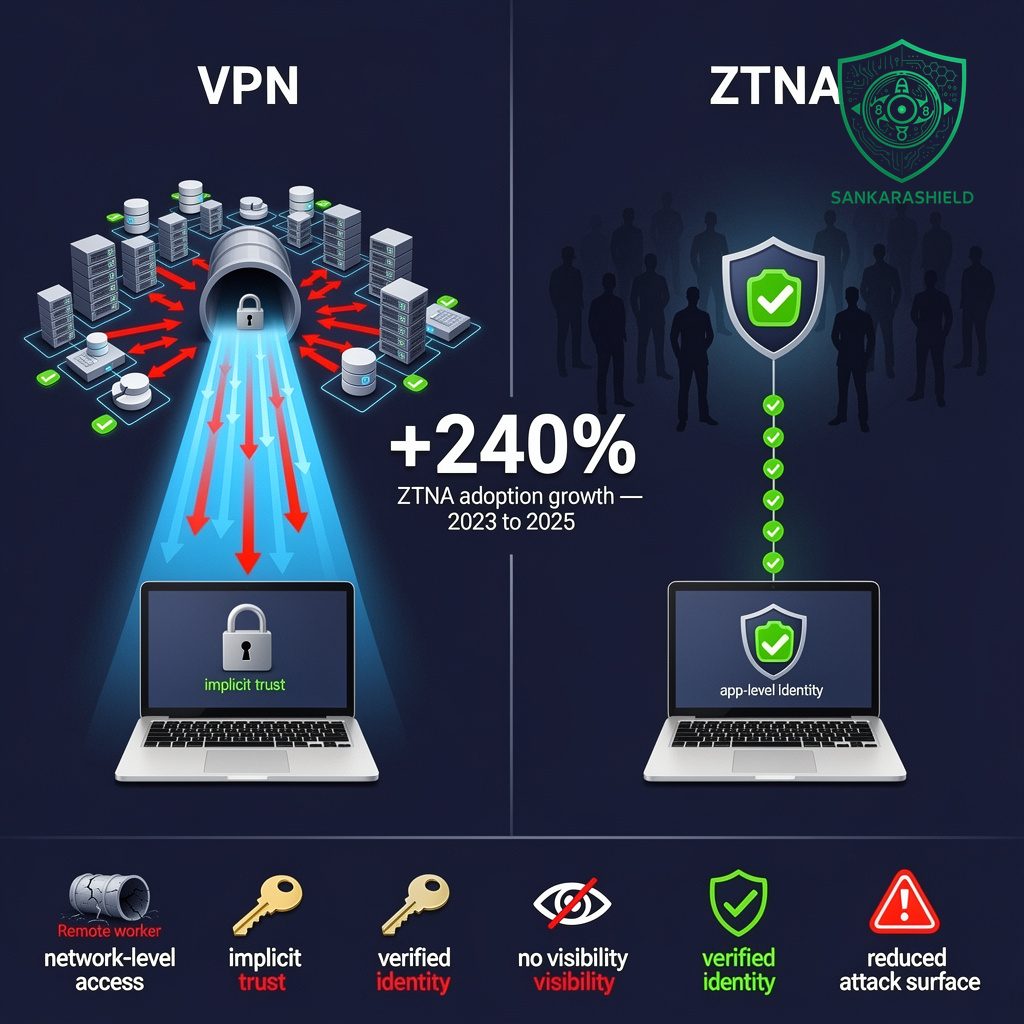
VPN technology was designed in the 1990s to extend a trusted perimeter to remote users. The core assumption: your network is safe, outside users need access, bring them inside. In 2026, there is no perimeter. There is no inside. That assumption is now the vulnerability. ZTNA adoption grew 240% between 2023 and 2025. The transition is accelerating.
WHY THE VPN MODEL FAILS TODAY
- NETWORK-LEVEL ACCESS A VPN user accesses the entire network segment — not just the application they need. Lateral movement from a compromised endpoint to a critical system requires no additional exploitation. The tunnel does the work.
- IMPLICIT TRUST Authentication happens once, at connection time. After that, all traffic is trusted. Stolen credentials and compromised devices inherit the same trust granted to legitimate users.
- VISIBILITY GAPS VPN tunnels are encrypted at the network level. Security tools see connections, not behavior. Lateral movement and data exfiltration remain invisible until damage is done.
- CONCENTRATED ATTACK SURFACE VPN appliances require public-facing endpoints. In 2024–2025, critical vulnerabilities in Ivanti, Fortinet, and Cisco VPN products were exploited at scale before patches could be applied. The VPN itself became the breach point.
WHAT ZTNA CHANGES
Zero Trust Network Access inverts the model. Users authenticate to a broker. The broker grants access to a specific application — not the network. Applications are never directly reachable from the internet.
- APPLICATION-LEVEL MICRO-SEGMENTATION Each user accesses only explicitly authorized applications. A compromised session grants access to nothing else. Lateral movement is architecturally prevented — not just policy-controlled.
- CONTINUOUS VERIFICATION Trust is evaluated continuously — device posture, behavior, location, risk signals. Anomalous activity triggers step-up authentication or immediate session termination.
- DIRECT-TO-APPLICATION ROUTING Traffic flows directly from user to application. No backhauling through a corporate gateway. SaaS performance improves. Network egress costs decrease.
- DARK NETWORK Applications sit behind the broker, invisible to external scanning. There is no public-facing endpoint to discover or exploit.
THE TRANSITION REALITY
ZTNA does not eliminate complexity — it relocates it. Identity governance becomes critical infrastructure. Device posture management must be comprehensive. Organizations deploying ZTNA without maturing their identity program replace one set of problems with another.
The migration is rarely instant. Hybrid architectures — ZTNA for cloud applications, VPN for legacy systems — are common during transition. The goal is a defined roadmap, not an indefinite hybrid state.
The architecture is correct. The implementation must be disciplined.
Has your organization begun migrating away from network-level VPN access? What is the main blocker?