Wi-Fi 7: The Next Generation Standard and Its Expanding Attack Surface
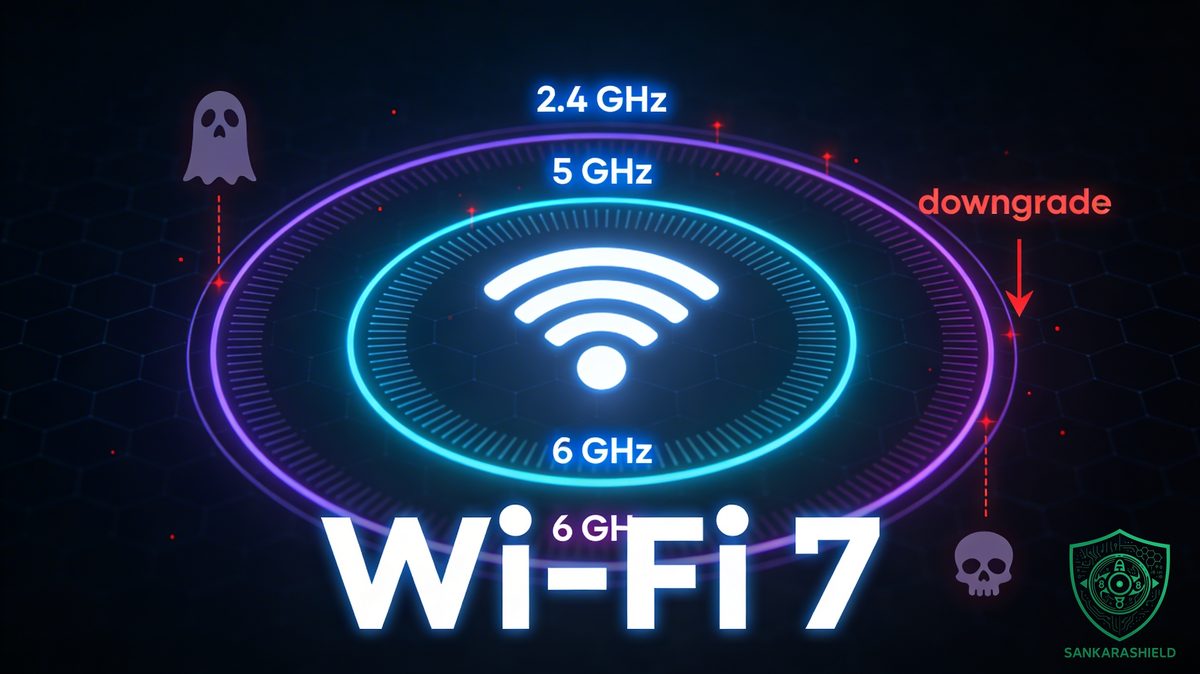
Wi-Fi 7 deployments are accelerating. Faster throughput, lower latency, better spectrum efficiency. The promise is real. So are the new risks.
802.11be introduces capabilities that fundamentally reshape the wireless threat landscape.
What makes Wi-Fi 7 different from a security standpoint
- MULTI-LINK OPERATION Devices connect simultaneously across 2.4 GHz, 5 GHz, and 6 GHz bands. Throughput reaches 46 Gbps. MLO adds complexity to authentication and session management. Security controls must span multiple simultaneous radio links.
- 6 GHZ BLIND SPOT The 6 GHz band is new territory. Legacy intrusion detection systems cannot see it. Most WIPS tools lack 6 GHz visibility. Rogue APs operating there go undetected. Security teams inherit blind spots the moment new APs go live.
- FASTER EXFILTRATION A compromised device on Wi-Fi 7 exfiltrates at 10x the rate of Wi-Fi 5. Detection windows shrink. Response time requirements tighten.
- MANAGEMENT FRAME COMPLEXITY 802.11be introduces new frame types and MLO state machines. Malformed or injected frames can destabilize clients or APs. Offensive research is just beginning. Defensive tooling has not kept pace.
Threats to watch
- EVIL TWIN ON 6 GHZ Rogue networks on 6 GHz face minimal detection. Clients connecting to the strongest signal may reach attacker-controlled infrastructure unnoticed.
- LEGACY COEXISTENCE WPA2 backward compatibility enables downgrade attacks. Legacy clients in mixed environments become the weakest entry point.
- SUPPLY CHAIN EXPOSURE New chipsets and firmware are freshly released. Early versions historically carry critical bugs. Vendor patch cadence must be tracked from day one.
What organizations must prioritize
- VISIBILITY FIRST Deploy 6 GHz-capable WIPS before or alongside new APs. You cannot defend what you cannot see.
- WPA3 ENFORCEMENT Disable WPA2 where feasible. Enforce WPA3-Enterprise with mutual certificate authentication. Remove WPA2-Personal from managed environments.
- ZERO TRUST FOR WIRELESS Isolate Wi-Fi 7 segments from sensitive infrastructure. Grant no implicit trust to wireless clients regardless of band or speed.
- FIRMWARE HYGIENE Track chipset CVEs actively. Treat wireless APs as critical infrastructure requiring a regular patch cadence.
- THREAT MODEL REFRESH Add MLO-specific attack scenarios. Account for 6 GHz visibility gaps. Extend red team scope to Wi-Fi 7 techniques.
The wireless perimeter no longer exists. Wi-Fi 7 extends that reality further.
Every new capability is also a new attack vector waiting to be mapped.
Security teams treating Wi-Fi 7 as a simple upgrade will inherit risks they did not plan for.
Has your organization updated its wireless security posture for Wi-Fi 7? What is your 6 GHz monitoring strategy?