5G Private Networks: The New Attack Surface for Critical Infrastructure
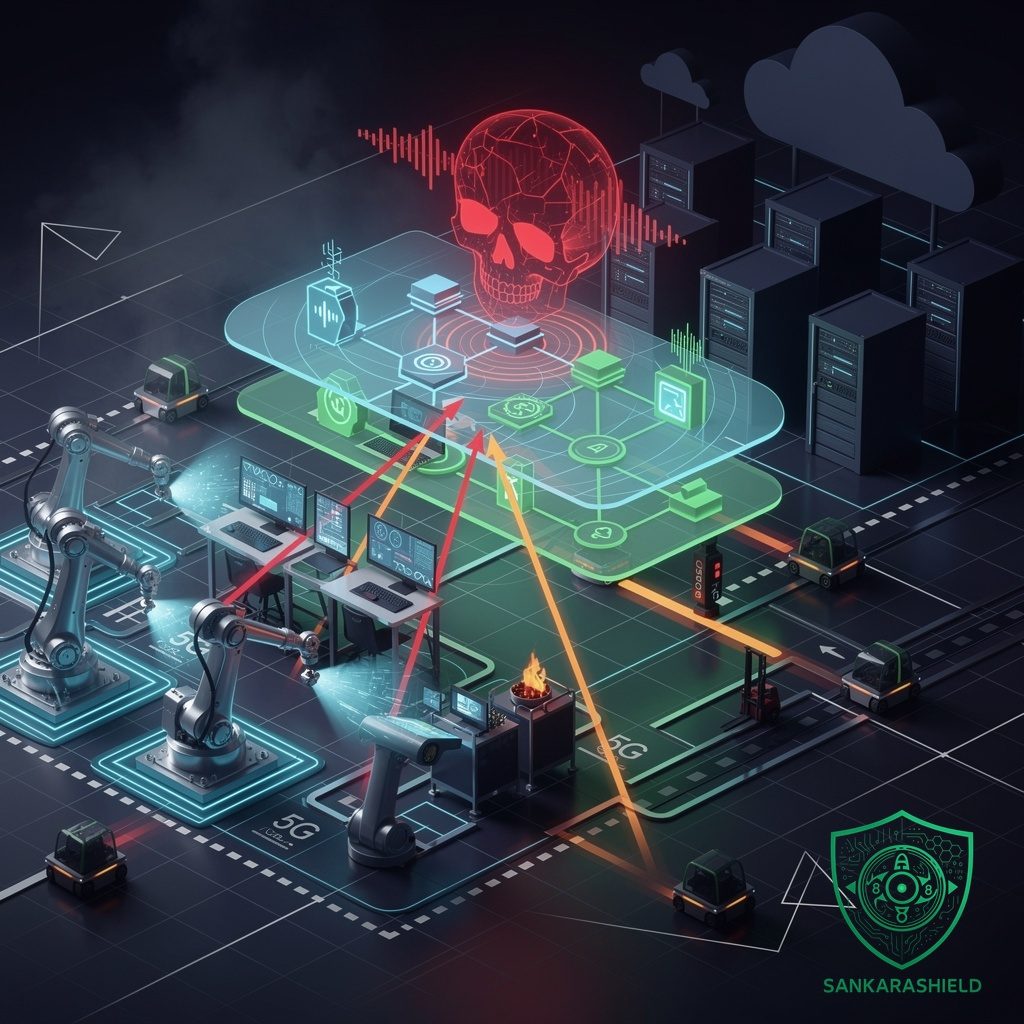
Private 5G networks are no longer a concept — they're being deployed right now across manufacturing floors, hospital campuses, seaports, and smart warehouses.
And most security teams are not ready for what comes with them.
The Promise Is Real
Private 5G delivers what enterprises have wanted for years: ultra-low latency, high device density, network slicing, and full ownership of the radio infrastructure. No shared spectrum. No dependency on a public carrier. Full control.
For OT environments — factories, utilities, logistics hubs — this is a massive leap. But "full control" also means full responsibility. And most OT/IT security teams are inheriting an architecture they weren't trained to defend.
What Makes Private 5G More Dangerous
Unlike Wi-Fi or LTE, private 5G introduces a full telecom stack into your enterprise environment:
- 5G Core (5GC): microservices-based network functions, often containerized on COTS hardware or cloud infrastructure. - gNB: radio layer deployed on-premise, communicating via N2/N3 interfaces. - SIM/eSIM provisioning: telecom-grade device identity — but who manages the lifecycle? - Network slicing: logical isolation that becomes a lateral movement path if misconfigured.
This stack sits between OT devices and your IT backbone — and its threat model is fundamentally different from what most enterprise security teams know.
The Attack Surface No One Mapped
1. Exposed 5G Core interfaces — N4 and SBI are often undersegmented. A compromised UPF can redirect all OT traffic.
2. Rogue base station risk — IMSI catchers and rogue gNBs are real threats without mutual authentication at the RAN layer.
3. SIM-based lateral movement — a compromised device inherits trusted network identity. Traditional NAC doesn't see this.
4. Third-party integrator access — a privileged path into your OT network, often without proper PAM controls.
5. No 5G-aware monitoring — your SIEM wasn't built for 5G core logs. Your NDR doesn't speak GTP-U. Visibility gaps are the norm.
What Good Looks Like
- Treat the 5G core as critical infrastructure — segment, monitor, harden it like ICS. - Enforce mutual TLS on all SBI interfaces. Audit NRF access policies. - Monitor the RAN continuously for rogue base station behavior. - Integrate SIM lifecycle into your identity governance program. - Require SOC-grade logging from your SI and support SIEM integration.
Private 5G is not the future. It's the present — and the attack surface is live.
The question is whether your security posture evolved with the network.
What's your biggest challenge securing private 5G or converged OT/IT networks? Drop it in the comments.